During the October 8th Township Council meeting, there were presentations from cannabis companies seeking to open two retail storefronts along US-130 in Robbinsville. The existing municipal framework allows two such dispensaries along the 3.5-mile stretch of US-130 in Robbinsville.
Currently, there are 14 licensed cannabis dispensaries operating along the 46-mile stretch of the US-130 corridor from Cranbury to Brooklawn, amounting to roughly one dispensary every 3.3 miles. The four companies that presented were Bud’s Goods, Breakwater, Leaf for Life, and Valley Wellness.
Before our township moves forward with issuing resolutions of support, our community deserves an honest, data-driven look at the proposed storefront locations, serious ethical conflicts on council, the lack of proactive transparency, and the economic, youth, and public safety numbers facing our neighborhoods.
Red flags on the map
Dispensaries at the doorsteps of our families and kids. Three of the four applicants disclosed exact physical locations on US-130, while Breakwater declined to publicly disclose its target property.
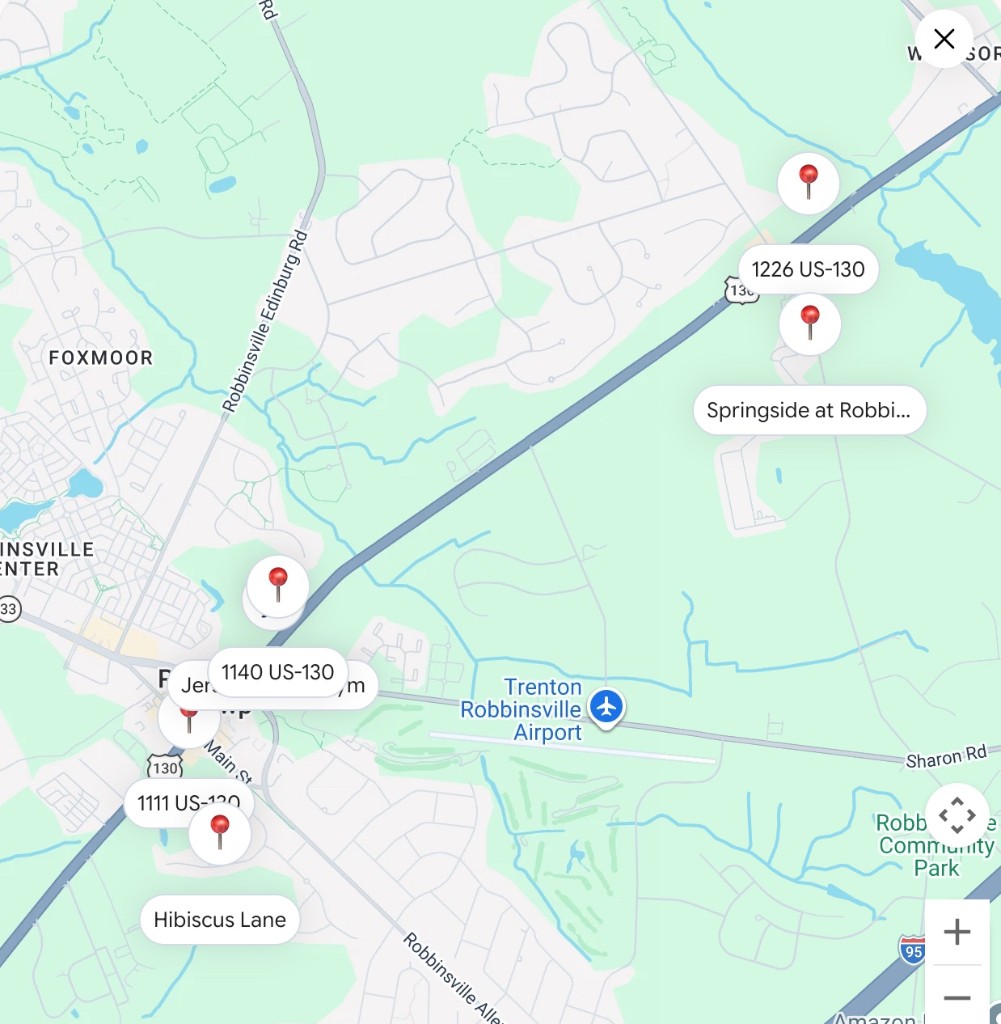
Bud’s Goods — 1111 Route 130
The former Chef Jason location. Positioned directly within the commercial complex that includes the Jersey Strong Gymnasium, a primary community fitness center heavily patronized daily by local high school athletes, teenagers, and families.
Valley Wellness — 1140 Route 130
Located just a five-minute walk from the Arbor Walk community, home to approximately 75 Robbinsville families.
Leaf for Life — 1226 US Route 130
Positioned within direct walking distance of the Springside community, home to approximately 150 local families.
These are not isolated, buffered industrial zones. These sites directly encroach upon family neighborhoods, pedestrian walking paths, and community commercial centers where Robbinsville High School students exercise, socialize, and commute daily.
The impact on our kids
Normalization, access, and walking distance. Placing retail cannabis dispensaries within walking distance of neighborhoods like Springside (about 150 families) and youth hubs like Jersey Strong, frequented daily by Robbinsville High School athletes and teenagers, creates immediate public health, safety, and developmental risks for our children.
- Normalization and underage access. When students walk past commercial cannabis storefronts on their daily routes, it desensitizes them to drug use during critical brain development years. Proximity directly correlates with higher rates of experimental use via older peers or adult acquaintances.
- The danger of edibles. Modern dispensaries sell a high volume of edibles, gummies, and beverages designed to look like conventional candy. Having these products retailed near residential walking paths and teen hangouts spikes the risk of accidental ingestion or underage consumption.
- Traffic and public safety hazards. High-turnover retail storefronts, especially those featuring drive-thrus like Bud’s Goods at the Jersey Strong plaza, increase traffic congestion and turning hazards directly in the paths where our teenagers walk, bike, and drive.
- Academic and developmental risks. Adolescent brains continue developing into the mid-20s, making them uniquely vulnerable to cannabinoids. Regular use during high school years is linked to impaired memory, reduced attention spans, and long-term mental health challenges.
As a candidate and a father who has walked our neighborhoods and talked to hundreds of parents, my stance is clear:
“Our community takes immense pride in our schools, our youth sports programs, and providing a safe, family-first environment. Placing commercial cannabis storefronts within walking distance of our kids’ daily paths, where they walk to school, practice sports, or work out at the gym, sends the wrong message. True leadership means protecting our children’s daily environments, not monetizing the highway corridor right at their front doors.”
Community leadership vs. community impact
The Leaf for Life paradox. The disconnect between community advocacy and cannabis commercialization was evident during the presentation by Mr. Hari Patel, Operations Director at BAPS and a self-announced stakeholder for Leaf for Life. Emphasizing his civic profile, Mr. Patel noted:
“In March of 2016, I was deeply honored to walk as a grand marshal in the Robbinsville St. Patrick’s Day Parade. For an Indian immigrant and a practicing Hindu, it was to receive that honor in an Irish American celebration. It was very special to me. When I look at that honor, not simply as an achievement, I see that as the fruit and testament to the relationships I have built over the years and to my commitment to the welfare of this community. I try to live life grounded in spirituality, service and constantly giving back. That philosophy becomes especially important with this particular business… I’m also a local resident and a father. I have 10-year-old twin daughters and a 16-year-old nephew that live with me and attend the middle school and high school in Robbinsville.”
Mr. Patel spoke at length about his involvement with the #WHATSMYNAME walk, local food drives, academic programs, and school sponsorships for robotics, clubs, and athletic field lighting. He even cited a personal story shared by Sharon Elementary Principal Paul Gizzo regarding adolescent mental health.
Yet this raises a fundamental contradiction: How can someone who takes pride in supporting Robbinsville school district activities, living by principles of service, and raising 10-year-old daughters and a high school nephew in this town, actively pursue opening a retail cannabis store within walking distance of 150 families in the Springside neighborhood? True commitment to the welfare of our children means protecting their immediate surroundings from adult-use commercialization, not monetizing the highway corridor at their front doors.
A clear conflict of interest
Campaign cash and council oversight. The ethical questions surrounding Leaf for Life do not end with commercial proximity; they reach directly onto the Township Council dais.
Official New Jersey campaign finance disclosures show that Councilman Ravi Patni, a former Land Use Board member who now sits on the council tasked with evaluating these applications, accepted a $500 direct campaign contribution from Hari Patel.
The two share well-known institutional, civic, and personal ties through BAPS. Yet, during the October 8th meeting, Councilman Patni sat on the dais, actively participated in the session, and questioned applicants competing for these two exclusive, highly lucrative municipal licenses.
Under basic principles of good governance and the spirit of the New Jersey Local Government Ethics Law (N.J.S.A. 40A:9-22.5), elected officials must avoid any direct or indirect personal or financial entanglements that could impair, or reasonably appear to the public to impair, their independence of judgment. An elected official cannot take campaign donations from an applicant and then act as an impartial judge vetting that applicant’s multi-million-dollar proposal against competitors.
Robbinsville residents deserve complete institutional integrity. Councilman Patni must publicly disclose this financial and personal relationship and commit to a full, formal recusal from all future deliberations, committee reviews, and council votes regarding Leaf for Life. Anything less compromises the public’s confidence in the fairness of the entire licensing process.
Cart before the horse
The Chapter 88 amendment and zoning in the dark. A foundational rule of responsible municipal planning is that zoning maps and protective land-use restrictions must be established before you open the door to commercial expansion. Robbinsville completely reversed this logic on July 9th, 2026, when the Township Council formally voted to approve an amendment to Chapter 88 of the township code.
As town officials admitted on the record during the rollout, this amendment expanded the number of Class 5 dispensary licenses without identifying a designated zone or mapping where these facilities would actually be permitted to operate. In plain terms: they wrote the commercial permissions first and left the zoning to be figured out later.
This ad-hoc, cart-before-the-horse approach created a regulatory vacuum that left residential neighborhoods completely exposed. By greenlighting licenses before setting strict geographic buffer zones or permanent commercial boundaries, the town invited applicants to scout their own preferred highway locations, landing directly at the doorsteps of our families.
What makes this failure of planning even more egregious is the background of our elected officials. Councilman Ravi Patni is a former Robbinsville Land Use Board member who frequently campaigns on his specialized expertise in municipal planning and zoning. Under any standard of competent local governance, a land-use professional should have immediately objected to amending Chapter 88 without a definitive zoning map. Instead, Councilman Patni raised zero objections on the dais during the July 9th vote. Months later, he sat silently in judgment when those very unzoned applicants pitched storefronts next to Robbinsville’s youth and family communities.
When town leadership abandons basic planning safeguards, residents pay the price. Robbinsville families should never be treated as an afterthought in a rushed, backwards zoning experiment.
The transparency gap
Televised meetings are not the same thing as meaningful community engagement. During the meeting, the administration praised the process, asserting that the township has handled cannabis through an open, vetted approach. In the Mayor’s own words:
“So over time we’ve phased in different classes, we’ve allowed over time. So you know, again, this just shows, you know, having everybody come in to a public meeting. You know, I applaud Council for having this at their meeting. So it’s not nothing’s done behind closed doors. Everybody here is the same information once, especially now that we’re, you know, televising our meetings that now the community has a better chance to hear everything that was said and understand different models of different applicants. So again, thank you to all the applicants for coming in and for spending the time for the prep and all the plans in the meetings you’ve had with our cannabis committee meeting as well.”
While the administration may tout that “nothing was done behind closed doors” because presentations occurred during a televised council session, there is a profound divide between technical compliance and genuine, proactive transparency.
Over the past several months, having knocked on hundreds of doors across Robbinsville, one reality has been unmistakable: virtually no one had heard of this cannabis presentation, let alone that dispensaries were being actively targeted near their neighborhoods.
Technically posting an agenda PDF on the municipal website 48 hours in advance or broadcasting a meeting on public access does not constitute true community outreach on an issue of this magnitude.
- Where was the township newsfeed bulletin? Robbinsville maintains an active digital newsfeed and email alert system designed precisely to inform subscribed residents about road closures, municipal events, and critical town updates. Why wasn’t a dedicated announcement sent to every subscriber alerting them that multi-million-dollar retail cannabis dispensaries were presenting site plans right next to Springside, Arbor Walk, and Jersey Strong?
- Real transparency demands outreach, not passive notice. If an issue significantly alters commercial corridors, introduces adult-use retail near local youth facilities, and impacts our neighborhoods, residents should not have to hunt through council agendas after the fact. Families in Arbor Walk (75 homes) and Springside (150 homes) deserved direct, advance notice long before site plans were pitched on the council floor.
- Behind closed committee doors. While the public presentations were televised, the Mayor himself noted the extensive preparation and “the meetings you’ve had with our cannabis committee.” Vetting applicants in closed subcommittees before bringing them to the dais leaves our community playing catch-up on decisions that permanently shape our town.
The police data
Who are we arresting, and who pays the overtime? Proponents of highway retail cannabis often claim that legal commercialization operates safely in the background. But Robbinsville Police Department arrest records tell a very different, empirical story about our highway corridors.
According to the official departmental arrest summary tracking 87 total adult drug-related incidents:
- Only 8 out of 87 arrests involved Robbinsville residents.
- 79 out of 87 arrests, 90.8%, involved individuals from outside Robbinsville passing through our highway corridors.
Route 130 and Route 33 already function as regional transit pipelines. When you place retail cannabis dispensaries directly on Route 130, you artificially manufacture thousands of weekly retail trips into our town from surrounding urban centers and out-of-county drivers. Because highway dispensaries overwhelmingly draw non-resident consumers (70% to 80% or more of total sales), that out-of-town offender ratio will become even more entrenched.
Furthermore, retail storefronts on state highways inevitably increase the volume of drug-impaired driving (DUI-D), unsealed container violations in vehicles, and roadside stops. Unlike alcohol, roadside THC testing requires extensive field sobriety tests and certified Drug Recognition Expert (DRE) call-outs, tying up officers for hours per incident.
The overtime trap for Robbinsville taxpayers. Every complex vehicle stop, DRE evaluation, and out-of-town court prosecution diverts Robbinsville patrol officers away from residential neighborhoods, like Arbor Walk, Springside, and Town Center, and onto Route 130. Because 90.8% of these offenders are from out of town, they contest charges in municipal court, driving up mandatory police overtime and court appearance costs.
Under New Jersey’s 2% transfer tax, these dispensaries are projected to net the town just $70,000 to $98,000 annually, less than $50,000 per store. When you factor in the soaring burden of police overtime and public safety responses required to manage transient drug traffic, that five-figure tax revenue is entirely wiped out.
Robbinsville taxpayers are essentially subsidizing the policing costs of out-of-town buyers so private commercial operators can profit right next to our children’s schools and neighborhoods.
The financial reality
Debunking outsized revenue projections. Presenting operators often highlight revenue figures achieved in dense urban centers to create an illusion of a massive fiscal windfall. Consider applicant Bud’s Goods & Provisions. Across their Massachusetts footprint, encompassing three dispensaries in Worcester, Watertown, and Abington, alongside an in-house wholesale manufacturing brand (Bud’s Everyday), their total annual enterprise revenue is estimated at approximately $14.1 million.
Context is critical:
- The population mismatch. Bud’s Goods operates in dense municipal centers led by Worcester (population about 211,000, New England’s second-largest city), Watertown (about 35,300), and Abington (about 17,000). Their three host communities represent a combined population exceeding 260,000 residents.
- Zero e-commerce or interstate shipping. Federal law strictly bars cross-state shipment or nationwide e-commerce for state-regulated cannabis. Every single dollar must come from physical, in-person retail storefront traffic.
- Corridor saturation in New Jersey. In Robbinsville (population about 19,000), two new storefronts would enter a mature market already bordered by Breakwater in Cranbury, Northeast Alternatives on US-130 in Hamilton, and over a dozen other active dispensaries throughout Mercer and Burlington counties.
Realistic revenue, and the 2% return
In New Jersey’s maturing adult-use market, statewide retail store averages have compressed to $2.5 million to $3.5 million annually. Permitting two dispensaries across Robbinsville’s short 3.5-mile strip will inevitably cannibalize local highway drive-by trips rather than double market demand.
A grounded pro forma for two stores on US-130 projects:
| Performance scenario | Store 1 annual gross | Store 2 annual gross | Combined township sales | Robbinsville 2% municipal share |
|---|---|---|---|---|
| Conservative case Heavy regional discount pressure | $1.8M | $1.6M | $3.4M | $68,000 / year |
| Moderate baseline Standard highway commuter pull | $2.6M | $2.3M | $4.9M | $98,000 / year |
| Optimistic case High-end retail draw and regional capture | $3.5M | $3.2M | $6.7M | $134,000 / year |
Under New Jersey’s 2% local transfer tax statute (CREMMA), a realistic baseline of about $4.9 million in combined retail volume yields roughly $98,000 annually for the entire township, less than $50,000 per store.
Furthermore, local Robbinsville residents will only generate 20% to 30% of these sales (about $20,000 to $29,000 in local tax revenue). The remaining 70% to 80% will be generated by transient highway drivers, out-of-town commuters, and warehouse shift workers utilizing our commercial corridor as a quick pit stop.
The social cost outweighs the fiscal return
Robbinsville’s modest 2% transfer tax yields roughly $70,000 to $100,000 annually. This nominal municipal revenue fails to justify community concerns regarding adolescent exposure, increased highway traffic, mounting police overtime, and the long-term erosion of our family-focused residential character.
A five-figure municipal tax revenue bump, representing a fraction of one percent of our overall municipal operating budget, does not justify:
- Placing commercial adult-use retail within steps of 225 or more families in Arbor Walk and Springside.
- Situating storefronts in high-traffic community sports and gym complexes like Jersey Strong.
- Increasing daily traffic congestion, left-turn hazards, and enforcement burdens on local police along US-130.
- Forcing local taxpayers to subsidize police overtime and court expenses for a 90.8% out-of-town offender population.
- Normalizing cannabis storefronts directly in the daily sightlines of our middle and high school students.
Our community identity has been built on award-winning schools, safe residential neighborhoods, and family-first planning. Selling out that character for $70,000 to $100,000 in highway tax receipts, while ignoring blatant conflicts of interest and flawed zoning on council, is a bad bargain for Robbinsville.